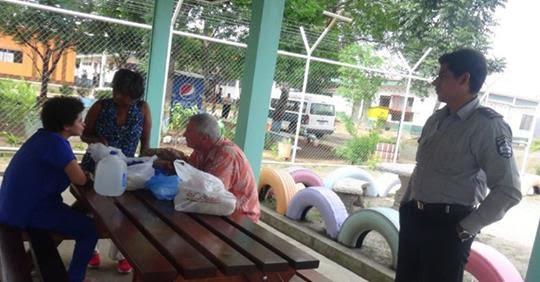
In its latest attempt to demonise Nicaragua, Amnesty International once again nails its colours to the mast of the right wing opposition. Its latest ‘Urgent Action’ campaign - see link here - denouncing the ‘wave of detentions of students and activists in Nicaragua’ is yet more proof that Amnesty has given up all pretence to be an impartial source of information about human rights in Nicaragua. Its report completely ignores the fact that those detained are not victims but the perpetrators of violent crimes. In addition to kidnapping, torture and murder, those who have been arrested are accused of sexual assault, looting, theft and the burning and destruction of public and private buildings, including municipal offices, health centres, historical places, private homes, schools and even pre-schools, universities, police stations and public and private transport units. Amnesty fails to mention any of this, preferring instead to stick to the myth that ‘students’ and ‘peaceful protesters; have been criminalised. They fail to mention the murder of Nicaraguan citizens, including 22 police officers, one of whom was tortured and his body burned on a public road. They fail to mention the murder of Sandinistas such as Lenin Mendiola, who died as a result of gunshots fired directly from an opposition march in Matagalpa on 11 August; they fail to mention the kidnapping, torture and murder of Bismarck Martinez Sanchez, another prominent Sandinista. It is the perpetrators of crimes such as these who have been arrested; these are the people being called ‘political prisoners’ by Amnesty International. One case named by Amnesty, that of Amaya Eva Coppens Zamora who is a dual Belgian/Nicaraguan citizen, is being picked out by campaigners as an example of an innocent ‘political prisoner’ who was merely exercising her right to protest. In fact, she has been arrested for various crimes, committed when she was in charge of road blocks erected by protesters in the city of León and elsewhere. These crimes include causing grievous bodily harm to two people kidnapped, assaulted and robbed at those road blocks. Coppens Zamora is currently under arrest awaiting trial on those very serious criminal charges brought by the Public Prosecutor’s office based on the testimony of various witnesses, as well as material and forensic evidence. Local media have published photographs and reports establishing that Coppens Zamora is in good health and has received visits from her parents. All those arrested have been detained in accordance with the law, which allows the police to detain a person for up to 48 hours on suspicion of participation in a criminal activity, and all detentions are fully reported in the national media, with an explanation as to the crime that people are accused of (see https://www.policia.gob.ni/?cat) Gustavo Porras, President of Nicaragua’s National Assembly, has issued a statement summarising the situation of those detained for offences carried out during the attempted coup in Nicaragua. The Government reports the following:- 204 people under arrest for crimes of terrorism or criminal violence detained in the prison system on the orders of the competent court. 187 are men: 181 indicted and awaiting criminal trial and 6 already sentenced by the courts but pending appeal 17 are women: 16 indicted and awaiting criminal trial and one already sentenced by the courts but pending appeal All detainees have access to lawyers of their choice and if they cannot afford one the public office will assign a public defender) and all are being presented to court within the legal time framework. In all cases, the prison system has guaranteed: • Medical check-up on entry to the prison system • Provision of bedding and prison uniform • Basic medical care depending on the accused’s medical needs • Fortnightly family visits of 3 continuous hours by up to 8 relatives per prisoner • Conjugal visits every fortnight for 2 continuous hours • Reception of food and articles of primary necessity once a week handed over by the prisoner’s family in the prison’s area of reception of packets • open air activity twice a week in the prison’s recreation facility • legal visits and court procedures in accordance with the criminal code. http://www.nscag.org/news/article/252/nscag-debunks-amnesty-claims-about-political-prisoners ADDENDUM BY CHUCK KAUFMAN What is a political prisoner? What is a political prisoner? Well, I think we can all agree that Lula in Brazil is a political prisoner. The charges against him were transparently trumped up to keep him from running for president in a race he would be sure to win. If you don’t agree with me that Mumia Abu Jamal is a political prisoner, that’s okay; I don’t know you and I don’t want to know you. Edwin Espinal in Honduras is a political prisoner too. He is a long-time leader of the opposition to the 2009 coup and is imprisoned without a court date in a maximum security prison, probably for the next two years. He’s got trumped up charges from the protests following the fraudulent 2017 presidential election. There are people in Nicaragua right now who are going before the courts in the aftermath of the political violence in the country since April. We’re not talking about a broken Starbucks or Wells Fargo Bank window, we’re talking about 22 dead policemen and 200+ civilians. We’re talking about people in demonstrations for and against the government shot in the head and chest by professional snipers. We’re talking about markets and government buildings and the homes of government supporters burned to the ground. We’re talking about robbery at the street barricades and sexual assault by young men “manning” the blockades. We’re talking about violence that goes beyond political speech and is a crime no matter the circumstances under which it is committed. Louise’s article above names some names and names some crimes. It also explains what rights and what treatment arrested individuals receive. Any country that does not guarantee this treatment of its delinquents, like Honduras, should be sanctioned by people of goodwill throughout the world. But such horrendous crimes cannot just be written off. The families of the dead deserve justice. The merchants burned out of their market stalls deserve justice. The people whose homes were torched or whose vital records were destroyed at city hall deserve justice. Nicaragua’s justice system is no more perfect than our own, but neither is it as corrupt as the Honduran judicial system or the Colombian judicial system or the Mexican judicial system. Investigations are ongoing into the violence committed from mid-April to early August. People against whom there is evidence will be tried for the crimes they are alleged to have committed and many of them will go to jail. Remember that Nicaragua doesn’t have capital punishment and even the murderous members of Somoza’s National Guard captured in 1979 only received 30 year sentences which were commuted after just a few years. Justice will prevail in Nicaragua, and those who go to jail will not be political prisoners; they will be violent criminals who have been brought to justice. |